
Friday, May 8, 2009

Saturday, May 2, 2009
Why do we use CSpro?
CSpro software was developed by census department, 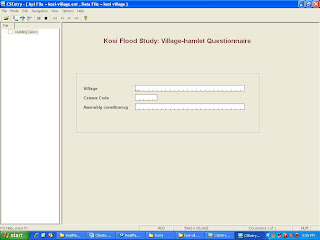 USA. It is available online and free. Anyone can use it and make templates according his/her questionnaire. Morsel used it for two survey; voter survey (in 35 districts of Uttar Pradesh) and Kosi River flood survey (5 districts of Bihar). With the help of this easy software, double entry and STATA, everyone can get a quality primary data.
 USA. It is available online and free. Anyone can use it and make templates according his/her questionnaire. Morsel used it for two survey; voter survey (in 35 districts of Uttar Pradesh) and Kosi River flood survey (5 districts of Bihar). With the help of this easy software, double entry and STATA, everyone can get a quality primary data.
 Origin of a question
This is story of a question. In the voter survey we (Avidit Acharya, from Princeton University and Morsel team) were trying to get questions like why people vote and how they select party. First we made a question in which villagers were asked to rate parties in 1-10 as per their liking. But we were working in villages where literacy rate is about 50 percent. As it was clear, this question did not work. 
Then second day of pilot survey, we tried to get answer according party caste (as BSP and SP are low caste party), it worked sometimes but we were not satisfied.
Next day we draw two questions; one for caste and one for class (we are trying to check a theory of Yogendra Yadav, according to which in Uttar Pradesh, people cast their votes on the basis of class not caste, poor Brahmins and Dalits did vote to poor party i.e. BSP in last assembly election). So, we sketched a ladder on cardboard and tried again but results were not very satisfactory.
In evening we were discussing the questionnaire and at once Avidit said, “Oh yes! Why not use money to get a sense what people think about parties that how they are redistributed public services and money.” Someone said “yes! It can work because even illiterate villagers understand the language of money. And they will do it for us.” “Let’s do that”, Avidit said. And then we invented two questions; one for the different castes and other for the classes. We tried to make this question very simple and conversational so that people could answer in one thought. We arranged three plates, one golden color (for upper class), other stainless steel (for middle class) and third clay plate (for lower class). Along this we put three caricatures (drawn by our team) on plates and then we bought some fake notes (used by kids in a game). That day of pilot campaign was very successful and we said to our team, “GO AHEAD.”

Then second day of pilot survey, we tried to get answer according party caste (as BSP and SP are low caste party), it worked sometimes but we were not satisfied.
Next day we draw two questions; one for caste and one for class (we are trying to check a theory of Yogendra Yadav, according to which in Uttar Pradesh, people cast their votes on the basis of class not caste, poor Brahmins and Dalits did vote to poor party i.e. BSP in last assembly election). So, we sketched a ladder on cardboard and tried again but results were not very satisfactory.
In evening we were discussing the questionnaire and at once Avidit said, “Oh yes! Why not use money to get a sense what people think about parties that how they are redistributed public services and money.” Someone said “yes! It can work because even illiterate villagers understand the language of money. And they will do it for us.” “Let’s do that”, Avidit said. And then we invented two questions; one for the different castes and other for the classes. We tried to make this question very simple and conversational so that people could answer in one thought. We arranged three plates, one golden color (for upper class), other stainless steel (for middle class) and third clay plate (for lower class). Along this we put three caricatures (drawn by our team) on plates and then we bought some fake notes (used by kids in a game). That day of pilot campaign was very successful and we said to our team, “GO AHEAD.”
Friday, April 17, 2009
Caste politics and redistribution: Evidence from Uttar Pradesh


This survey based study was held in 35 districts (250 villages) of Uttar Pradesh. Our team stayed for 1 day in each village and conducted several activities. In this survey we had two type of samples. One is for household survey and another for village survey (based on participatory rural appraisal).
{From top to bottom: Best trainee award to Rashmi and Santosh given by Atulesh, village survey, household survey, team always utilize free time, survey and village mapping, trying to get answer in question related to how political parties redistributed money and public services among three classes of society (question is asking to distribute money among three plates representing three classes; a perfect lichter scale)}
Wednesday, April 15, 2009
When they were searching for life, Morsel was there


Climate change is the biggest debate in the world and flood is one example of its impact. Morsel with Indian statistical Institute (
{From top to bottom: Professor Rohini Somanathan (Delhi School of Economics) and Sarubh Srivastava (Morsel) discussing with the villagers about their problems after
Tuesday, April 14, 2009
This is how we found Bihar after flood in Kosi river

We were in Bihar to collect different data. When Morsel team(Bhartendu, Atulesh, Abhijeet and others) entered the state, sight was horrible. Most of the bridges were drowned deep into the flood water. Some of them were broken badly.
See these pics and get to know that how tough it was to work in these areas of Bihar. But still our project team did an excel
 lent work and provided good results.
Sunday, April 12, 2009
Campaigns to Influence Voting Behavior in India
Project Overview: With young democracies facing challenges across the developing world, efforts are underway to mobilize voters in order to make elected officials more accountable for delivering results. Unfortunately, we observe that in many places, voters do not seem to use candidates' performance or policy priorities as their key criteria. Beyond these observations, little rigorous evidence exists to explain individuals' voting behavior in low-income countries, or how voters' actions can improve government outcomes. Does voting behavior based on ethnicity, caste or gender outweigh voting based on issues and performance in poor, rural communities? Can voter mobilization or education campaigns lead to more accountable government? These questions are currently being addressed using experimental data that compares the behavior of voters in randomly selected villages exposed to a voter campaign with the behavior of voters in a comparable set of villages that were not included in the campaign. Several campaigns were carried out by a local NGO to test the influence of interventions such as entertainment, "dialoguing," community meetings, and posting materials on voting behavior.
To see whether campaigns could induce voters to hold corrupt officials accountable, one campaign provided an anti-corruption message along with publicly-available information about incumbents' performance in office. Another campaign focused on reducing caste-based voting, by helping communities identify issues of importance to them and encouraging people to vote based on those issues rather than for parties associated with their castes. Finally, a female voter mobilization campaign was designed to measure whether election outcomes would be more representative of women's priorities if more women voted.
Policy Relevance:
The results of this evaluation will provide valuable information about rural voters' behavior. In addition, the estimated impacts of various voter education/mobilization campaigns will suggest ways for governments and NGO's to increase communities' capacity to hold their elected leaders accountable for their performance.
Courtesy- JPAL (http://www.povertyactionlab.com/)
To see whether campaigns could induce voters to hold corrupt officials accountable, one campaign provided an anti-corruption message along with publicly-available information about incumbents' performance in office. Another campaign focused on reducing caste-based voting, by helping communities identify issues of importance to them and encouraging people to vote based on those issues rather than for parties associated with their castes. Finally, a female voter mobilization campaign was designed to measure whether election outcomes would be more representative of women's priorities if more women voted.
Policy Relevance:
The results of this evaluation will provide valuable information about rural voters' behavior. In addition, the estimated impacts of various voter education/mobilization campaigns will suggest ways for governments and NGO's to increase communities' capacity to hold their elected leaders accountable for their performance.
Courtesy- JPAL (http://www.povertyactionlab.com/)
Subscribe to:
Posts (Atom)
